

PAICS deficiency (OMIM #619859) is an extremely rare autosomal recessive disorder of de novo purine synthesis (DNPS). As of September 2026, six patients from four unrelated families have been reported. PAICS deficiency has a broad clinical spectrum, ranging from severe congenital malformations and early neonatal death to progressive neurodevelopmental disease.
Clinical spectrum
The clinical presentation is highly variable and currently includes the following patterns:
- Severe congenital malformation syndrome: the first two affected siblings had multiple craniofacial, oesophageal, pulmonary, vertebral, rib, limb and urogenital abnormalities. Both died during the early neonatal period.
- Congenital malformations with survival and preserved neurodevelopment: a subsequently reported boy had a polymalformative syndrome including congenital heart disease and skeletal and oesophageal abnormalities, but normal neurodevelopment at seven years of age.
- Predominantly neurodevelopmental disease: two siblings were born after uncomplicated pregnancies and had no major congenital malformations. They subsequently developed early-onset epileptic encephalopathy, severe psychomotor impairment, progressive cerebral atrophy and retinopathy.
- Combined congenital and neurodevelopmental phenotype: the most recently reported patient had oesophageal atresia, lung hypoplasia, vertebral abnormalities, cryptorchidism, short stature and dysmorphic facial features together with developmental delay, but without epilepsy.
Molecular and biochemical basis
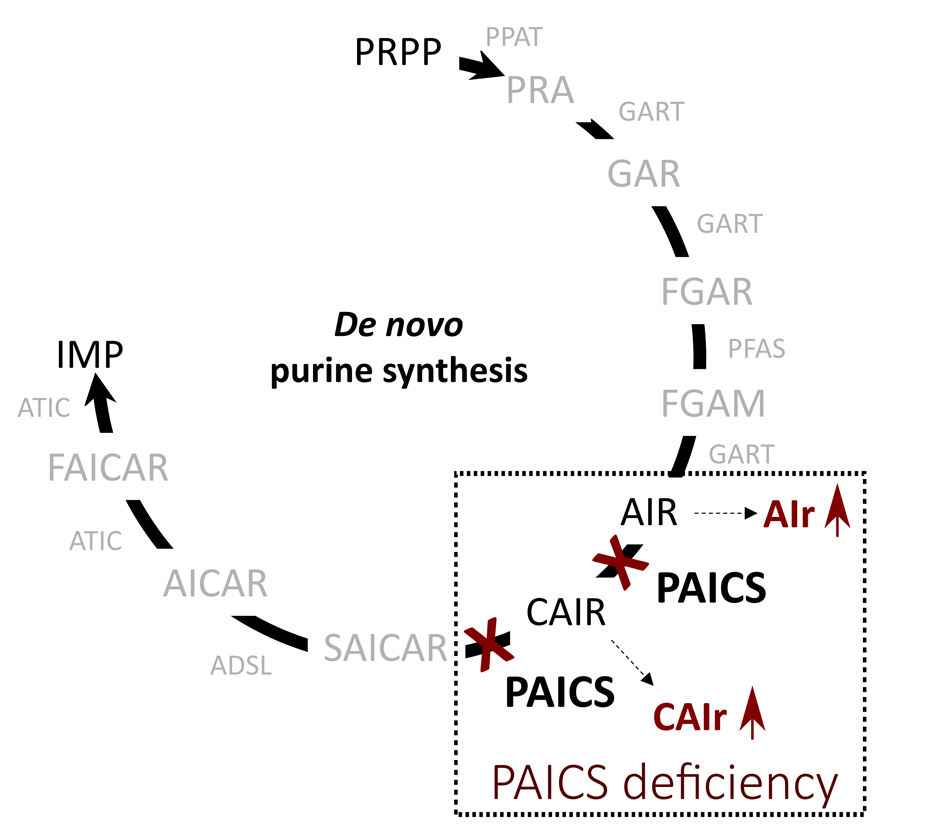
The PAICS gene encodes a bifunctional enzyme that catalyses two consecutive reactions of DNPS. Its aminoimidazole ribonucleotide carboxylase domain (AIRc; EC 4.1.1.21) converts AIR to CAIR, while its SAICAR synthetase domain (SAICARs; EC 6.3.2.6) converts CAIR to SAICAR, the substrate of adenylosuccinate lyase.
Pathogenic PAICS variants may impair catalytic activity, protein stability and purinosome assembly.
The following disease-associated variants have been reported using transcript NM_001079524.2:
| Variant(s) | Genotype and reported individuals |
|---|---|
| c.158A>G, p.(Lys53Arg) | Homozygous recurrent variant; three confirmed patients from two unrelated families |
| c.535T>C, p.(Ser179Pro) c.1207C>T, p.(Arg403Ter) |
Compound heterozygous variants; two affected siblings |
| c.104C>T, p.(Ser35Phe) c.843_844del, p.(Cys281Ter) |
Compound heterozygous variants; one patient |
Diagnosis
PAICS deficiency is usually identified by exome or genome sequencing.
Biochemical analysis can provide important functional confirmation. The dephosphorylated PAICS substrates aminoimidazole riboside (AIr) and carboxyaminoimidazole riboside (CAIr) are elevated in plasma and urine and represent the biochemical markers of PAICS deficiency.
Functional studies of PAICS enzyme activity and DNPS organization in patient-derived fibroblasts or peripheral blood mononuclear cells may further support the interpretation of novel variants.
Management
There is currently no established disease-modifying treatment for PAICS deficiency and no standardized clinical management guideline. Care is therefore individualized and supportive and may include surgical correction of congenital abnormalities, treatment of epilepsy, developmental and rehabilitation therapies, nutritional support and ophthalmological follow-up. Genetic counselling should be offered to affected families.
Literature
View the published PAICS deficiency case reports in PubMed