Inherited defects of de novo purine synthesis (DNPS) are ultra-rare metabolic disorders that predominantly affect the nervous system, although their clinical presentation ranges from severe congenital abnormalities and neonatal disease to milder neurodevelopmental phenotypes.
|
ADSL deficiency ADSL encodes adenylosuccinate lyase, which participates in DNPS and in the purine nucleotide cycle. ADSL deficiency is characterized by accumulation of SAICAr and SAdo and a broad spectrum of predominantly neurological manifestations. |
AICAribosiduria / ATIC deficiency ATIC encodes the bifunctional enzyme catalyzing the final two reactions of DNPS. ATIC deficiency, also known as AICA-ribosiduria, is characterized by accumulation of AICAr, SAICAr and SAdo and predominantly neurological and visual manifestations. |
|
PAICS deficiency PAICS encodes a bifunctional enzyme catalyzing two consecutive reactions of DNPS. PAICS deficiency is characterized by accumulation of AIr and CAIr and with a broad clinical spectrum ranging from severe congenital abnormalities to neurodevelopmental disease. |
PFAS deficiency PFAS encodes phosphoribosylformylglycinamidine synthase, which catalyzes the fourth reaction of DNPS. The disorder is associated with accumulation of FGAr. |
DNPS is a highly conserved metabolic pathway responsible for the synthesis of purine nucleotides from phosphoribosyl pyrophosphate (PRPP). The pathway consists of ten enzymatic reactions catalyzed by six enzymes and leads to the formation of inosine monophosphate (IMP), the precursor of AMP and GMP. The DNPS enzymes form to purinosome:
PPAT → GART → PFAS → PAICS → ADSL → ATIC
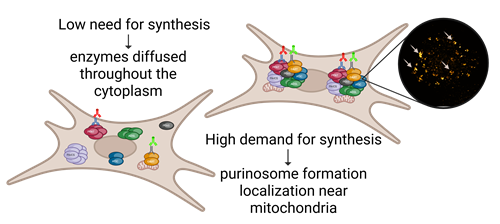
Created in BioRender.com
Pathogenic variants causing human inherited disorders have so far been described in PFAS, PAICS, ADSL and ATIC.
Our group studies inherited disorders of DNPS from diagnosis and biochemical characterization to disease mechanisms and development of experimental therapies.